


















































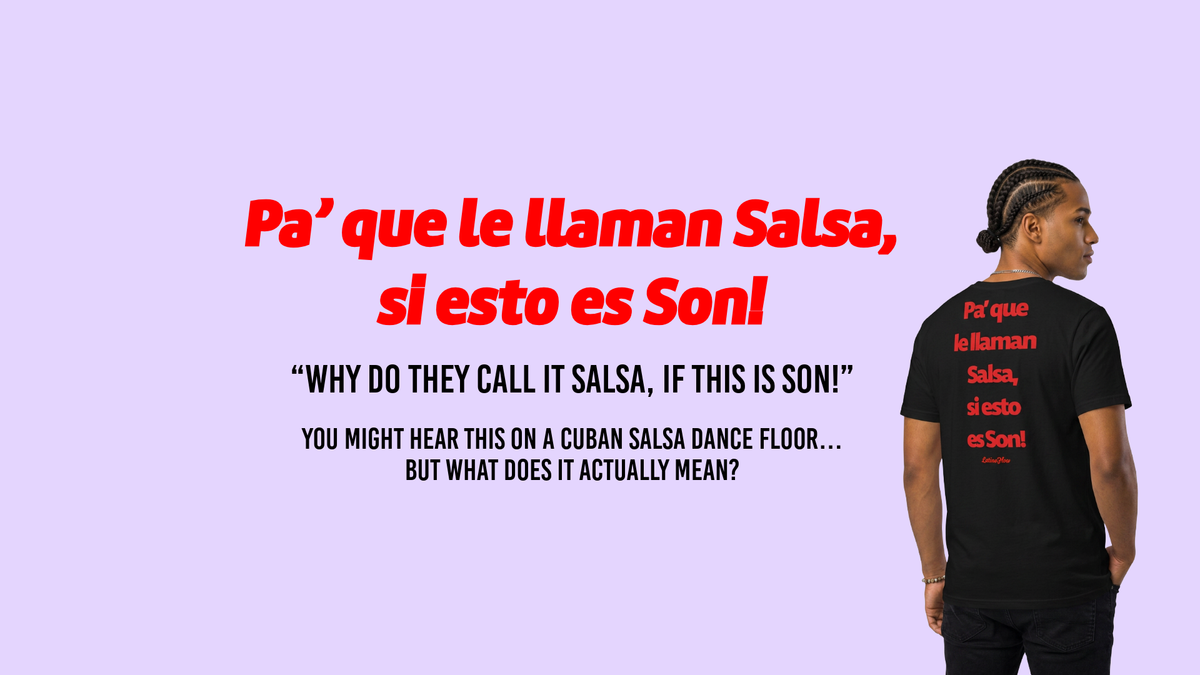
“Pa’ que le llaman salsa, si esto es son” – What this phrase reveals about the true roots of salsa
When you step onto a Cuban salsa dance floor, you might hear someone say:
“Pa’ que le llaman salsa, si esto es son.”
Very few stop to consider what it actually means.
In reality, this simple phrase captures a fundamental question about salsa history:Where does salsa really come from, and why do we call it “salsa”?
The birth of salsa: a new name for existing music
Salsa music developed primarily in New York City during the 1960s and 1970s. It did not emerge from nothing, but rather from a fusion of Caribbean musical styles, strongly influenced by Cuban rhythms and jazz elements.
The term “salsa” (Spanish for “sauce”) reflects this mixture. It was used to describe music that was not a clearly defined genre, but instead a combination of different influences.
In this sense, salsa did not originally represent entirely new music, but rather a new way of naming and presenting existing styles to a broader audience.
Why is son considered the foundation of salsa?
A key question arises: why is Son cubano so often identified as the core of salsa?
The answer lies not in opinion, but in musical structure. Son cubano underpins salsa on three essential levels: rhythm, form, and instrumentation.
Rhythmic foundation: clave
Both son and salsa are built around the clave rhythm, which acts as the structural backbone of the music. Clave is not just another rhythm — it is an organizing principle that shapes the entire composition.
Without this rhythmic logic, neither genre functions in the same way.
Song structure: son montuno
Many salsa songs follow a structure that transitions from a verse into a montuno section — a repetitive, rhythmically driven segment that emphasizes improvisation and interaction.
This structure is directly inherited from son cubano, particularly its son montuno form.
Instrumentation and musical language
The sonic identity of salsa also relies heavily on elements derived from son cubano, including:
- bongos and congas
- bass tumbao patterns
- piano montuno structures
While salsa often features a more modern and expanded orchestration, its underlying musical “engine” remains closely tied to son.
What does the phrase actually mean?
When a Cuban musician or dancer says:
“Pa’ que le llaman salsa, si esto es son”
they are not claiming that salsa and son are identical.
Rather, the phrase expresses a perspective:
the name has changed, but the musical foundation remains.
It serves as a reminder that salsa is part of a longer historical continuum that is not always immediately visible through terminology alone.
Cultural perspective: roots and diaspora
The phrase also carries cultural meaning. It reflects the fact that many of salsa’s defining elements originate in Cuba, even though the genre developed and gained international popularity elsewhere.
Salsa emerged in a diasporic context — where music moved across borders and evolved in new environments. The new name was part of this transformation, helping introduce the music to wider audiences.
What does this mean for dancers?
When you dance Cuban salsa, you are not only reacting to modern music. You are moving within a rhythmic system that has developed over more than a century.
The dance reflects:
- the same rhythmic logic as son
- the same interactive musical structure
- the same cultural lineage
This adds depth to the experience: it is not just movement, but participation in a historical tradition.
Salsa and son: opposition or continuity?
A common question is whether salsa or son is more “authentic.”
However, this opposition can be misleading.
Salsa:
- brought the music to a global audience
- integrated diverse cultural influences
- created a new diasporic identity
Son:
- provides the structural foundation
- represents historical roots
- preserves the original context
It is more accurate to understand them as part of a continuum:
salsa is an evolution, son is the foundation.
Conclusion
The phrase “Pa’ que le llaman salsa, si esto es son” may sound like a casual remark, but it conveys a deeper insight into the history of music.